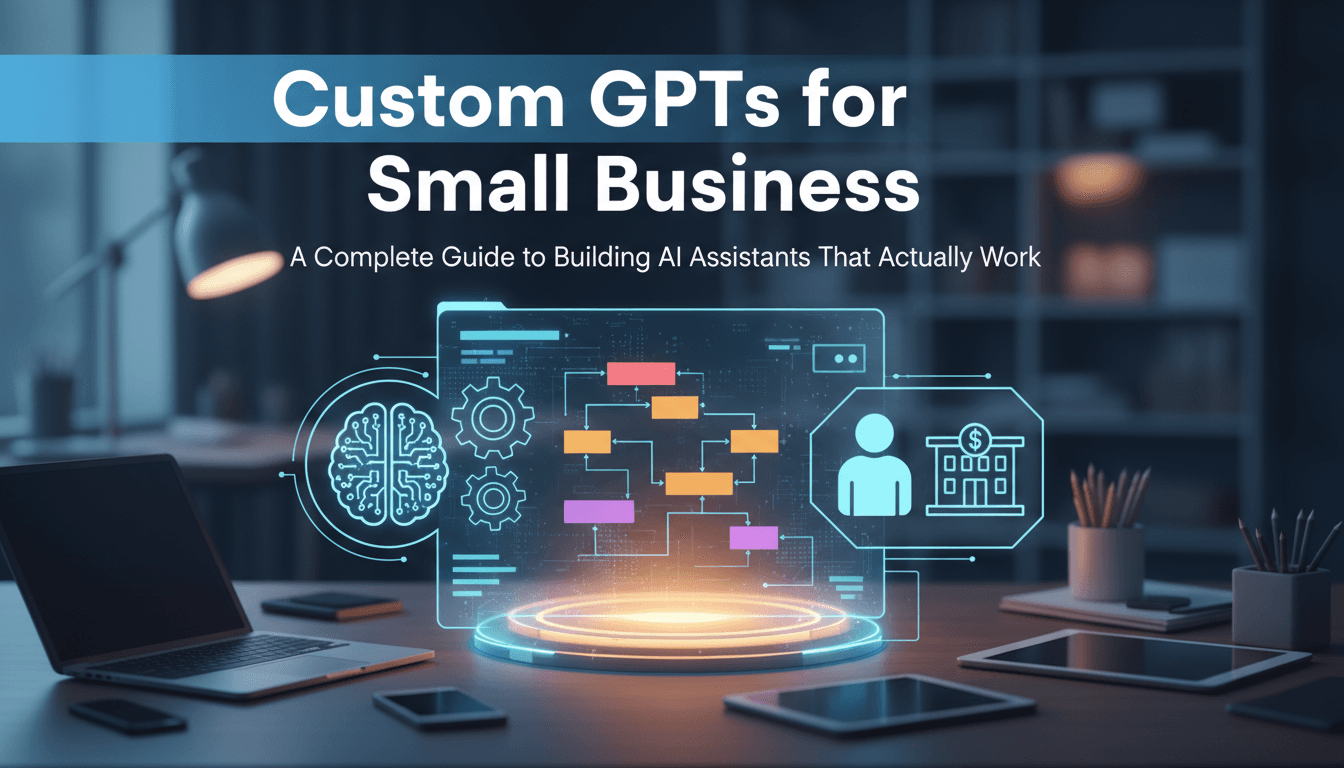
Custom GPTs for Small Business: Build AI Assistants That Work
In this guide, you'll learn what custom GPTs are, how they differ from standard AI tools, and how to build and deploy them effectively for your small business.
Every small business owner knows the feeling: you're drowning in repetitive tasks, answering the same customer questions for the hundredth time, and wishing you could clone yourself just to keep up. What if you could create a digital assistant that knows your business inside and out, speaks in your voice, and handles those repetitive tasks while you focus on growth?
That's exactly what custom GPTs offer. These aren't the generic AI chatbots you've probably experimented with. Custom GPTs are specialized AI assistants built specifically for your business, trained on your documents, configured with your rules, and designed to handle the exact workflows that eat up your time.
In this comprehensive guide, you'll learn what custom GPTs actually are, how they differ from standard AI tools, and most importantly, how to build and deploy them effectively for your small business. Whether you run a local service company, an e-commerce store, or a professional services firm, you'll discover practical applications that can transform your operations starting today.
What Exactly Are Custom GPTs?
Think of a custom GPT as a specialist contractor versus a general handyman. A standard AI assistant like ChatGPT is incredibly capable, but it's a generalist. It can help with almost anything, but it doesn't know the specifics of your return policy, your service areas, your pricing structure, or the particular way you like to communicate with customers.
A custom GPT takes that powerful foundation and layers on specialized knowledge and behavior. You're essentially training an AI assistant to become an expert in one specific aspect of your business.
The Technical Reality (Without the Jargon)
At its core, a custom GPT sits on top of a powerful language model like GPT-4. But instead of responding as a general-purpose assistant, it follows specific instructions you've provided. These instructions might include:
- Role definitions: "You are a customer service representative for a family-owned plumbing company in Denver"
- Behavioral guidelines: "Always recommend scheduling a consultation for complex issues rather than giving DIY advice"
- Tone and voice: "Be friendly and conversational, use 'we' language, avoid technical jargon unless the customer uses it first"
- Knowledge boundaries: "Only answer questions about services we actually offer, which are listed in the uploaded documents"
Beyond instructions, custom GPTs can access your own documents and data. Upload your FAQ pages, service descriptions, pricing guides, company policies, and product catalogs, and the assistant can reference this information when responding.
The result is an AI that behaves less like a generic robot and more like a well-trained team member who has memorized your entire operations manual.
How Custom GPTs Differ from Standard AI Assistants
When you use a standard AI chatbot, every conversation starts fresh. You might need to explain your business context, remind it of your preferences, and guide it toward the response style you want. With a custom GPT, all of that configuration is baked in from the start.
Consider this comparison:
Standard AI Assistant:
- Knows general information about many topics
- Requires context with each conversation
- May suggest approaches that don't fit your business
- Responds in a generic, neutral voice
- Can't access your specific business data
Custom GPT:
- Specializes in your specific use case
- Maintains consistent behavior across all conversations
- Follows your business rules and constraints
- Uses your brand voice and terminology
- References your uploaded documents and policies
This distinction matters enormously for small businesses. You don't need an AI that can write poetry and solve calculus problems. You need one that can accurately answer questions about your return policy at 2 AM or draft outreach emails that sound like they came from your sales team.
Where to Build and Access Custom GPTs
The landscape for creating custom AI assistants has evolved rapidly, and you have several options depending on your technical comfort level and specific needs.
Platform-Native Solutions
The most accessible option for many small businesses is building directly within major AI platforms. ChatGPT, for example, now includes a GPT Builder feature that lets you create custom assistants through a conversational interface. You describe what you want, upload relevant documents, and the platform generates a specialized assistant.
This approach requires no coding knowledge. The configuration happens through natural language prompts, and you can iterate by simply telling the system what to change. The learning curve is minimal, and you can have a working custom GPT in under an hour.
These platform-native custom GPTs can be kept private for your team, shared with specific people, or even published to public marketplaces where others might discover and use them.
Third-Party Specialized Tools
Beyond the major AI platforms, a growing ecosystem of specialized tools focuses specifically on creating custom AI assistants for business applications. These platforms typically offer features designed for commercial deployment:
- Website embedding: Drop a chat widget on your site that connects to your custom assistant
- Multi-source integration: Pull knowledge from your website, help center, CRM, and document repositories
- Analytics dashboards: Track what questions customers ask most frequently and how well the AI handles them
- Human handoff: Automatically route complex inquiries to your team while the AI handles routine questions
- Brand customization: Match the assistant's appearance to your website design
These tools often cost more than building within a standard AI platform, but they provide the infrastructure needed to deploy customer-facing assistants at scale.
Enterprise and API Options
For businesses with technical resources or specific integration requirements, working directly with AI APIs offers maximum flexibility. This approach requires development expertise but allows for deep integration with your existing systems, custom interfaces, and precisely tailored behavior.
Most small businesses won't need this level of customization initially, but it's worth knowing the option exists as your AI capabilities mature.
High-Impact Use Cases for Small Businesses
The businesses seeing the greatest return on custom GPTs aren't using them as novelties. They're deploying them as targeted workflow tools that solve specific, recurring problems. Here are the applications generating real results.
Customer Support and FAQ Automation
This is often the highest-impact starting point for small businesses. If you're answering the same questions repeatedly, whether about pricing, hours, policies, processes, or basic troubleshooting, a custom GPT can handle these interactions around the clock.
What this looks like in practice:
A local HVAC company uploads their service descriptions, pricing guides, service area map, and FAQ document. Their custom GPT can now answer questions like:
- "Do you service addresses in Lakewood?"
- "How much does a furnace inspection cost?"
- "What's included in your annual maintenance plan?"
- "How do I schedule an appointment?"
The assistant knows exactly what the company offers, where they operate, and what their policies are. It won't make up services they don't provide or quote prices that don't exist.
Beyond automated responses, a support-focused custom GPT can draft replies for your team to review. Instead of writing each email from scratch, a team member reviews an AI-generated draft, makes minor adjustments, and sends. This approach maintains human oversight while dramatically reducing response time and effort.
Sales and Lead Generation Support
Sales teams, even solo entrepreneurs handling their own sales, spend enormous amounts of time on repetitive communication tasks. Custom GPTs excel at these workflows.
Outreach and follow-up sequences: Configure a GPT with your ideal customer profiles, value propositions, and successful email examples. It can generate personalized outreach messages, follow-up sequences, and re-engagement emails that sound like they came from your best salesperson.
Call preparation and summaries: Before a sales call, your GPT can pull together relevant information about the prospect, suggest talking points, and identify potential objections based on similar past conversations. After the call, it can transform your rough notes into structured summaries with clear next steps.
Lead qualification on your website: A custom GPT embedded on your site can engage visitors, explain your offerings, answer initial questions, and collect qualifying information (budget, timeline, specific needs) in a conversational format. This information feeds directly into your sales process, giving you warmer leads with more context.
For businesses looking to scale their outreach efforts, combining custom GPTs with automated content systems can create a powerful lead generation engine.
Marketing and Content Production
Content marketing remains one of the most effective strategies for small businesses, but it's also one of the most time-consuming. Custom GPTs can dramatically accelerate your content production while maintaining brand consistency.
On-brand content generation: Upload your brand guidelines, past successful content, and positioning statements. Your marketing GPT learns your voice, terminology, and approach. When you ask for a blog outline, social post, or email campaign, the output already sounds like your brand rather than generic AI content.
Content repurposing at scale: One piece of high-quality content can become dozens of distribution pieces. Turn a blog post into a newsletter intro, a LinkedIn article, a series of social posts, a video script outline, and an FAQ entry. Your GPT handles the transformation while maintaining consistent messaging.
Campaign coordination: Configure a GPT that understands your current offers, seasonal promotions, and marketing calendar. It can help draft coordinated campaigns across channels, ensuring your email, social, and advertising messaging stays aligned.
The key to effective AI-powered marketing is understanding how these tools complement rather than replace strategic thinking. Your custom GPT handles execution while you focus on strategy.
Operations and Internal Processes
Many small businesses overlook internal applications, but custom GPTs can be transformative for operational efficiency.
The "how do we do this?" problem: Every growing business accumulates processes, policies, and procedures. But that knowledge often lives in scattered documents, email threads, and people's heads. A custom GPT trained on your SOPs, handbooks, and internal documentation becomes an always-available operations guide.
New hires can ask "How do we process a return?" or "What's our policy on remote work?" and get accurate answers instantly. Existing team members can refresh their memory on rarely-used procedures without hunting through folders.
Document drafting assistance: Proposals, quotes, job descriptions, contracts, project briefs, task lists—the paperwork of running a business never ends. A custom GPT loaded with your templates and past examples can generate first drafts that need only minor refinement.
Meeting and communication efficiency: Transform meeting notes into action items, draft agendas based on standing topics and recent developments, or convert long email threads into executive summaries.
Analytics and Decision Support
Small businesses often have data but lack time to analyze it properly. Custom GPTs can bridge this gap by summarizing information and extracting actionable insights.
Customer feedback synthesis: Upload your recent reviews, support tickets, and survey responses. Your GPT can identify common themes, flag urgent issues, and suggest specific improvements. What might take hours of reading becomes a structured summary in minutes.
Competitive research organization: Have your GPT analyze competitor websites, pricing pages, and positioning to create comparison tables and strategic notes. You provide the raw information; it organizes and presents it in actionable formats.
Data interpretation support: While GPTs shouldn't be your sole source for critical business decisions, they can help interpret data, identify patterns, and suggest questions worth investigating further.
Building Your First Custom GPT: A Practical Framework
Understanding possibilities is one thing; actually building an effective custom GPT is another. Here's a practical framework for getting started.
Step 1: Identify Your High-Friction Workflow
Don't try to automate everything at once. Look for workflows that share these characteristics:
- High volume: You deal with this task frequently
- Predictable patterns: The inputs and outputs follow recognizable patterns
- Time-consuming: The task takes meaningful time but doesn't require your unique judgment for every instance
- Well-documented: You have existing materials that describe how to handle the task correctly
Common starting points include:
- Answering routine customer questions
- Drafting outbound sales or marketing emails
- Creating internal documentation or procedures
- Summarizing information for decision-making
Pick one workflow for your first custom GPT. Resist the urge to expand scope before proving value.
Step 2: Gather Your Configuration Materials
Your custom GPT is only as good as the information and instructions you provide. Gather:
Role and behavior instructions:
- What role should this assistant play?
- What should it always do? What should it never do?
- What tone and communication style should it use?
- How should it handle questions outside its scope?
- What are the boundaries of its authority?
Knowledge documents:
- FAQ pages and support articles
- Product or service descriptions
- Pricing information and policies
- Process documentation and SOPs
- Example communications (emails, chat transcripts, etc.)
- Brand voice guidelines
Example interactions:
- Show the GPT what good looks like
- Include examples of correctly handled questions
- Demonstrate your preferred response format and length
Be selective with documents. More isn't always better. Include only what's truly relevant to the specific workflow this GPT will handle.
Step 3: Configure and Test
Using your chosen platform, create your custom GPT by:
- Writing clear system instructions that define the role, rules, and constraints
- Uploading relevant documents that provide necessary knowledge
- Setting response parameters (length, format, style preferences)
Then test extensively:
- Ask questions you know customers ask
- Try edge cases and unusual scenarios
- Attempt to get the GPT to break its rules
- Have team members test independently
Document what works and what doesn't. Note where responses miss the mark or require adjustment.
Step 4: Deploy Gradually
Start with low-risk deployment:
Internal assistant mode: Your team uses the GPT as a drafting and research tool. Humans review and edit all outputs before they reach customers or get used for decisions.
Shadow mode: Run the GPT alongside your normal process. Compare its outputs to what you'd produce manually. Track accuracy and identify gaps.
Limited exposure: Once quality stabilizes, expand usage gradually. Maybe the GPT handles certain categories of questions while humans handle others. Or it powers a chat widget during off-hours when response expectations are lower.
Full deployment: With confidence in quality and established monitoring processes, expand to full customer-facing or operational use.
Step 5: Monitor and Iterate
Your custom GPT will need ongoing refinement. Establish processes to:
- Review conversation logs regularly
- Track questions the GPT handles poorly or escalates frequently
- Update documents when policies or information change
- Add new examples as edge cases emerge
- Refine instructions based on actual performance
The best custom GPTs evolve continuously based on real-world usage patterns.
Common Pitfalls and How to Avoid Them
As businesses rush to implement custom GPTs, certain mistakes appear repeatedly. Learning from others' errors can save you significant time and frustration.
Overscoping Your First Project
The temptation to build an "everything assistant" is strong. Resist it. A GPT configured to handle customer support, sales outreach, marketing content, and internal operations will likely do none of them well. Start narrow, prove value, then expand.
Insufficient Documentation
Custom GPTs can't read your mind. If you haven't documented your policies, processes, or preferences, the GPT will guess—often incorrectly. The build process often reveals documentation gaps you didn't know existed. Consider this a feature, not a bug.
Neglecting Edge Cases
Standard questions are easy. The challenge comes with unusual situations, complex requests, and attempts to misuse the system. Test thoroughly with scenarios beyond the happy path.
Skipping Human Oversight
Even well-configured GPTs make mistakes. Build in human review processes, especially for customer-facing interactions and important decisions. The goal is augmentation, not complete automation, at least initially.
Forgetting to Update
Your business changes. Prices shift, policies evolve, services expand. If your GPT's knowledge becomes stale, it will provide outdated information. Build maintenance into your regular workflows.
Ignoring User Experience
A technically capable GPT with a frustrating user experience will go unused. Consider conversation flow, response length, clarification handling, and handoff to humans when needed.
The Business Case for Custom GPTs
For small businesses weighing the investment, the return potential is compelling when approached strategically.
Time Savings
The most immediate benefit is recovered time. If your custom GPT handles 50 routine customer questions per week—questions that previously took 5 minutes each—you've recovered over four hours weekly. Scale that across multiple workflows and the impact compounds.
Consistency and Quality
Human responses vary. People have good days and bad days, remember some details and forget others, communicate differently with different customers. A well-configured GPT delivers consistent quality every time, following your best practices without fail.
Scalability Without Hiring
Growing businesses often face a choice between missing opportunities and hiring before they can afford to. Custom GPTs provide a middle path—handling increased volume without proportional cost increases.
Customer Experience Improvement
Faster responses, 24/7 availability, and consistent helpfulness improve customer satisfaction. While customers may know they're talking to an AI, they care more about getting their questions answered than about who (or what) answers them.
Team Focus Optimization
When routine tasks are handled automatically, your team focuses on work that truly requires human judgment, creativity, and relationship-building. This often improves job satisfaction alongside business outcomes.
Getting Started Today
The gap between businesses leveraging custom GPTs and those that aren't is widening. Early adopters are building competitive advantages that will compound over time.
You don't need to transform your entire operation overnight. Start with these concrete steps:
This week: Identify your two or three most repetitive communication or information retrieval tasks. Which ones follow predictable patterns?
Next week: Gather existing documentation for your highest-priority task. What policies, examples, and guidelines already exist? What needs to be created?
Following weeks: Build your first custom GPT focused on that single workflow. Test internally. Gather feedback. Refine.
The businesses thriving with AI aren't necessarily the most technical or well-funded. They're the ones willing to experiment, learn, and iterate. Custom GPTs lower the barrier to entry enough that any small business can start building meaningful AI capabilities today.
Your competitors are likely exploring these tools right now. The question isn't whether custom GPTs will matter for small businesses—it's whether you'll be leading or catching up when they become standard practice.