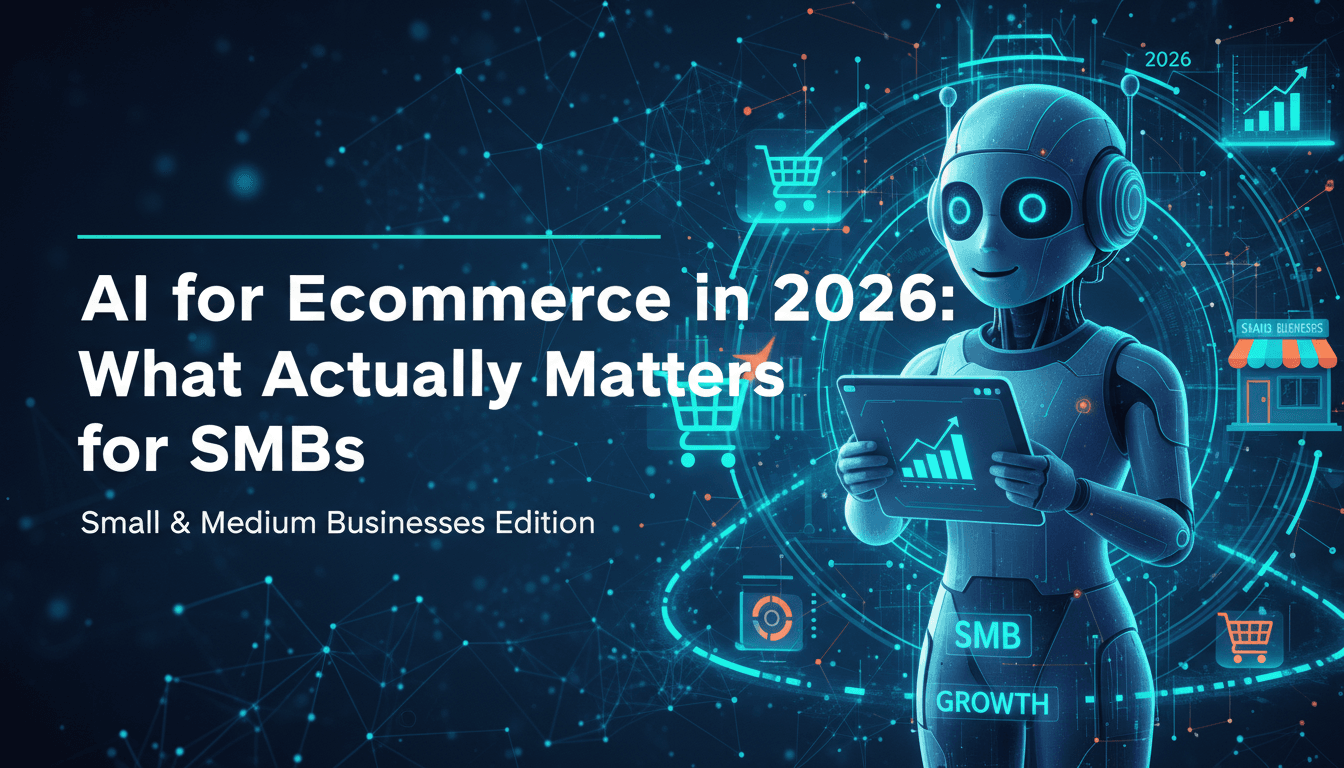
AI for Ecommerce in 2026
We're looking at somewhere around 70-80% of ecommerce businesses now using or at least piloting AI in some capacity
Look, I've been watching the AI-ecommerce space evolve for a while now, and honestly? 2026 feels like the year where everything kind of clicked into place. Not in a "robots are taking over" way, but more like... the tools finally got good enough and accessible enough that small ecommerce businesses can actually use them without needing a tech team or a massive budget.
The numbers backing this up are pretty striking. We're looking at somewhere around 70-80% of ecommerce businesses now using or at least piloting AI in some capacity. That's not just the big players anymore. And here's what really caught my attention: AI-assisted shopping sessions are converting up to four times more than traditional experiences. Four times. That's not a marginal improvement you can ignore.
But let me back up a bit, because I think there's a tendency to treat "AI in ecommerce" as this monolithic thing when it's really a bunch of different applications solving different problems. Some of them matter a lot for small businesses. Others are honestly more hype than substance at this point.
The shift nobody's really talking about
What's actually happening in 2026 isn't just that AI tools got better. It's that shopping itself is changing in ways that favor businesses using AI.
Here's what I mean. Customers are increasingly comfortable with conversational interfaces. They're typing questions into search bars the way they'd ask a friend. "What's a good gift for someone who likes cooking but already has everything?" That kind of thing. Traditional keyword-based search can't really handle that. AI-powered search can interpret intent, figure out what you probably mean, and surface relevant products even from pretty vague descriptions.
And then there's this concept of "zero-click" shopping that's starting to gain traction. AI agents that can compare options, factor in your constraints (budget, delivery time, specific features), and essentially do the shopping for you. It's more developed in B2B right now, especially for recurring orders and replenishment, but it's creeping into consumer ecommerce too.
This matters for small businesses because it changes what you're competing on. It's less about who can buy the most ad impressions and more about who can actually show up in these AI-mediated discovery moments with the right product at the right time.
Personalization that actually moves the needle
I used to be somewhat skeptical of personalization claims. Every ecommerce platform has been promising "personalized experiences" for years, and mostly what they delivered was "you looked at shoes, here are more shoes."
But the current generation of AI personalization is genuinely different. These systems are looking at scroll depth, comparison patterns, how long you linger on certain details, what you've put in carts before without buying, the context of your current session. And they're making real-time adjustments to recommendations, content, even offers.
The reported numbers here are significant. Companies doing this well are seeing revenue uplifts around 40% compared to non-personalized experiences, with higher average order values and better repeat purchase rates. That's the kind of impact that can transform the economics of a small ecommerce business.
What's interesting is that personalization is increasingly about building confidence rather than just showing relevant products. The AI is surfacing things like accurate delivery windows, sizing guidance based on what similar customers bought and kept, verified reviews from people with similar preferences, return policy details that matter for that specific product. It's addressing hesitation, which is often what kills conversions.
If you're running Shopify, for instance, there are now AI personalization apps that dynamically adjust bundles and discounts in the cart based on behavior patterns from similar customers. Some brands are reporting double-digit AOV lifts from this alone.
Conversational commerce isn't just chatbots anymore
I want to distinguish between two things that often get lumped together.
The first is basic customer service automation. Chatbots that handle order tracking, return requests, simple product questions. These are genuinely useful, and the data suggests retail chatbots can increase sales significantly while reducing response times. They resolve the majority of inquiries without human intervention, which frees up time for more complex issues.
The second thing is what I'd call genuine conversational commerce. AI that can actually help someone figure out what they need, guide them through options, handle objections, and facilitate a purchase in a way that feels more like talking to a knowledgeable salesperson than filling out forms.
We're getting closer to that second thing, but it's still uneven. Some implementations are genuinely impressive. Others are basically keyword-matching with a chat interface. If you're evaluating tools in this space, actually test them with weird, off-script questions. That's where you see the difference.
For small businesses, I think the practical play right now is solid chatbot coverage for the routine stuff. If you're handling a lot of pre-purchase questions or your support queue is consistently backed up, this is probably where you start. The more ambitious conversational selling capabilities are worth watching but might not be the first priority unless you're selling something complex enough to warrant it.
The marketing and content side
This is probably where most small businesses are already touching AI, even if they don't think of it that way. Marketing and content creation are the leading AI use cases for small businesses right now.
The applications are pretty straightforward: generating ad copy, writing product descriptions, creating email sequences, producing social content. What's changed is how integrated these tools have become with the actual platforms you're using. AI isn't sitting in some separate tool you copy-paste from. It's built into your ecommerce platform, your email service, your ad accounts.
There's also this newer category of AI tools that will design entire ecommerce storefronts. They create homepage layouts, product page structures, landing pages optimized for conversion. I've seen these produce surprisingly good results for businesses just getting started who don't have design resources.
If you're already doing marketing with AI tools, the next level is really about testing velocity. AI lets you create more variations of ads, copy, and creative than you ever could manually. The businesses getting the most value are treating this as an experimentation engine, not just a content production shortcut.
Operations: where the quiet wins happen
There's less sexy stuff happening on the operations side that honestly might matter more for profitability than the customer-facing applications.
AI-driven demand forecasting is one of those areas. The tools analyze your sales history, seasonality, promotional calendars, and increasingly external signals to set better purchase quantities and reorder points. The reported improvements are meaningful: roughly 20-30% reduction in inventory holdings while maintaining service levels, better on-time delivery, lower logistics costs.
For a small ecommerce business, inventory issues are often a silent profit killer. You're either leaving money on the table from stockouts or tying up cash in overstock that eventually gets discounted. Better forecasting directly hits your bottom line.
Pricing is the other operational area worth watching. Dynamic and algorithmic pricing tools for SMBs are becoming a real thing. These adjust prices based on demand signals, competitive pricing, inventory levels, and elasticity patterns. For businesses with larger catalogs, this can unlock significant margin and conversion improvements that you'd never capture with manual pricing.
This is harder to implement well than some of the other applications. You need decent data, and you need to think carefully about how aggressive you want the algorithms to be. But for businesses selling products where price sensitivity varies a lot or where you're constantly reacting to competitor moves, it's worth investigating.
What an AI "stack" actually looks like for small ecommerce
Surveys suggest the typical small business now uses around five AI tools as part of their regular operations. For ecommerce specifically, the common starting points are:
First, whatever AI features are built into your platform. Shopify, BigCommerce, the marketplaces - they've all been adding AI capabilities, and these are usually the easiest entry point because there's no integration work.
Second, something for marketing and content. Whether that's a dedicated tool or just using ChatGPT effectively, most businesses start here because the value is immediate and obvious.
Third, customer service automation. Even a basic chatbot handling FAQs and order status inquiries saves time.
Fourth, analytics and basic predictive tools. This ranges from simple AI-enhanced reporting to more sophisticated customer lifetime value predictions and churn risk scoring.
And then, depending on your specific pain points, you add specialized tools for inventory forecasting, pricing optimization, personalization, or whatever else makes sense for your business.
The important thing is that these tools are increasingly interconnected. Your email platform can pull predictions from your analytics. Your chatbot can access your inventory system. AI is becoming less a set of point solutions and more of a nervous system that connects different parts of your business.
Starting points based on where it hurts
One piece of advice that I keep coming back to: start with your actual pain points, not with "what AI is capable of."
If your biggest problem is content production - you can't create enough product descriptions, ad variations, email content, social posts to keep up with what you need - then marketing AI tools are your starting point. This is usually the fastest path to seeing ROI.
If customer support is drowning you - you're spending hours every day on repetitive questions, response times are suffering, customers are frustrated - then chatbot and automation tools are where to focus.
If inventory keeps biting you - either stockouts during peak periods or cash trapped in slow-moving products - then forecasting and inventory optimization tools make sense.
If pricing feels like guesswork - you're either leaving margin on the table or losing sales to competitors and you don't really know which - then pricing tools become interesting.
And if conversion is the issue - you're getting traffic but not enough of it is turning into purchases - then personalization and search optimization deserve attention.
The mistake I see businesses make is trying to implement everything at once. The businesses getting real value from AI are usually picking one or two high-impact areas, getting those working well, learning from the experience, and then expanding.
The competitive landscape has shifted
Here's the uncomfortable truth: by 2026, using AI in ecommerce isn't really optional anymore. It's increasingly central to how competitive businesses operate.
This isn't about some abstract future scenario. It's about the fact that AI-native competitors can scale quickly with small teams. They're producing more content, testing more variations, responding to customers faster, optimizing prices more intelligently, and making better inventory decisions than businesses doing these things manually.
If you're a small ecommerce business and you're not using AI in at least some capacity, you're probably already at a disadvantage. Not because AI is magical, but because the basics - content creation, customer service, inventory management, pricing - can all be done significantly better and faster with AI assistance.
The flip side is that AI tools are now accessible enough that you don't need to be a tech company to use them. The playing field hasn't just tilted toward AI users. It's also become more level between big and small businesses who are both using AI effectively.
Questions worth asking yourself
If you're thinking about your AI roadmap for the next year or so, here are some of the questions I'd be sitting with:
For customer acquisition: How will you show up in conversational search and generative AI results? What AI tools will let you test more ad creative and targeting variations with your current budget?
For on-site experience: Are your product discovery and recommendations actually reducing friction, or just adding noise? Could you offer some form of conversational shopping that genuinely helps customers decide?
For retention: What signals predict churn or reactivation opportunity for your specific customers? How much of your outreach is still batch-and-blast versus genuinely individualized?
For operations: Where are you losing margin or service quality because of poor forecasts or static pricing? What data would you need to feed AI tools to get reliable outputs?
And honestly, for governance: How are you ensuring customer data gets used transparently? How would you catch and correct AI decisions that could damage trust?
The practical path forward
I think the realistic path for most small ecommerce businesses in 2026 looks something like this:
Start by getting your data in order. This doesn't mean building some elaborate data infrastructure. It means making sure your customer data, sales history, and product information are organized enough that AI tools can actually work with them. Most platform-native AI features require surprisingly little setup here.
Then deploy AI for the routine stuff. Use it for research, communication, content creation. Get comfortable with how these tools work and what they're good at.
Pick one high-impact area beyond the basics. Whether that's personalization, inventory forecasting, pricing optimization, or something else depends entirely on your specific pain points. Pilot it. Measure what actually happens. Learn from it.
And then expand based on results, not hype. The businesses I've seen do this well are iterative and evidence-based. They're not chasing every new AI announcement. They're focused on what measurably improves their business.
What this actually means for small ecommerce
I want to end on something that might sound counterintuitive: AI doesn't change the fundamentals of what makes an ecommerce business work. You still need products people want, messaging that resonates, pricing that makes sense, service that doesn't frustrate people, and operations that actually deliver.
What AI changes is how efficiently and effectively you can do all of that. It compresses the time between having an idea and testing it. It lets a three-person team do things that used to require a department. It catches patterns you'd never see manually and makes adjustments faster than any human could.
But it's still a tool. The businesses winning with AI aren't the ones with the most sophisticated technology. They're the ones who understand their customers, know their pain points, and use AI strategically to address them.
The opportunity in 2026 is real. The gap between businesses using AI well and businesses ignoring it is widening. But the path forward isn't about implementing everything or chasing the latest capabilities. It's about being thoughtful, starting where it matters most, and building from there.
That's honestly the most useful thing I can tell you. The tools are there. The question is just whether you'll use them.